

The Purest Sandbelt Original

Founded in 1913 as Mordialloc Golf Club and renamed Woodlands in 1925, we are the only historic club in the Sandbelt region that has remained on its original site throughout our entire history.
Where others moved and expanded, we stayed true to our roots, evolving thoughtfully whilst preserving the strategic essence that makes traditional Sandbelt golf extraordinary.
Strategy Over Strength. Heritage Over Trend.
A Walk Through Woodlands
We are a Thinking Golfer’s Paradise. We don’t hide behind excessive length; instead, we challenge you with small, firm, fast greens and tight fescue surrounds.
Whether you are a traveling enthusiast on a Sandbelt pilgrimage or looking for your forever club, Woodlands offers an authentic experience where you don’t just play a round; you join a legacy.
View The Course
The Architects of Woodlands
Our course bears the fingerprints of some of the most influential figures in Australian golf course architecture.
J.D.A. Scott
English golf architect who came to Australia in the mid-1920s. His advice on course bunkering and the potential for new holes laid the architectural foundations that still define the layout.
Mick Morcom
The lauded greenkeeper at Royal Melbourne, Morcom was commissioned to report on conditions and provided counsel on greens preparation, seeding, and conditioning. His influence helped transform raw farmland into championship-calibre turf.
Alec Russell
Partner to the legendary Alister MacKenzie, Russell reshaped key sections of the course in the mid-1930s, designing the 11th, 16th, and 17th holes. His influence brought a layer of strategic sophistication that remains intact today.
Tom Doak
One of the modern game’s most celebrated architects, Doak designed our Centenary 19th hole in 2013 — and rated our 15th as one of the 18 best par 5s in the world. He regards Woodlands as one of the finest courses on the Sandbelt.
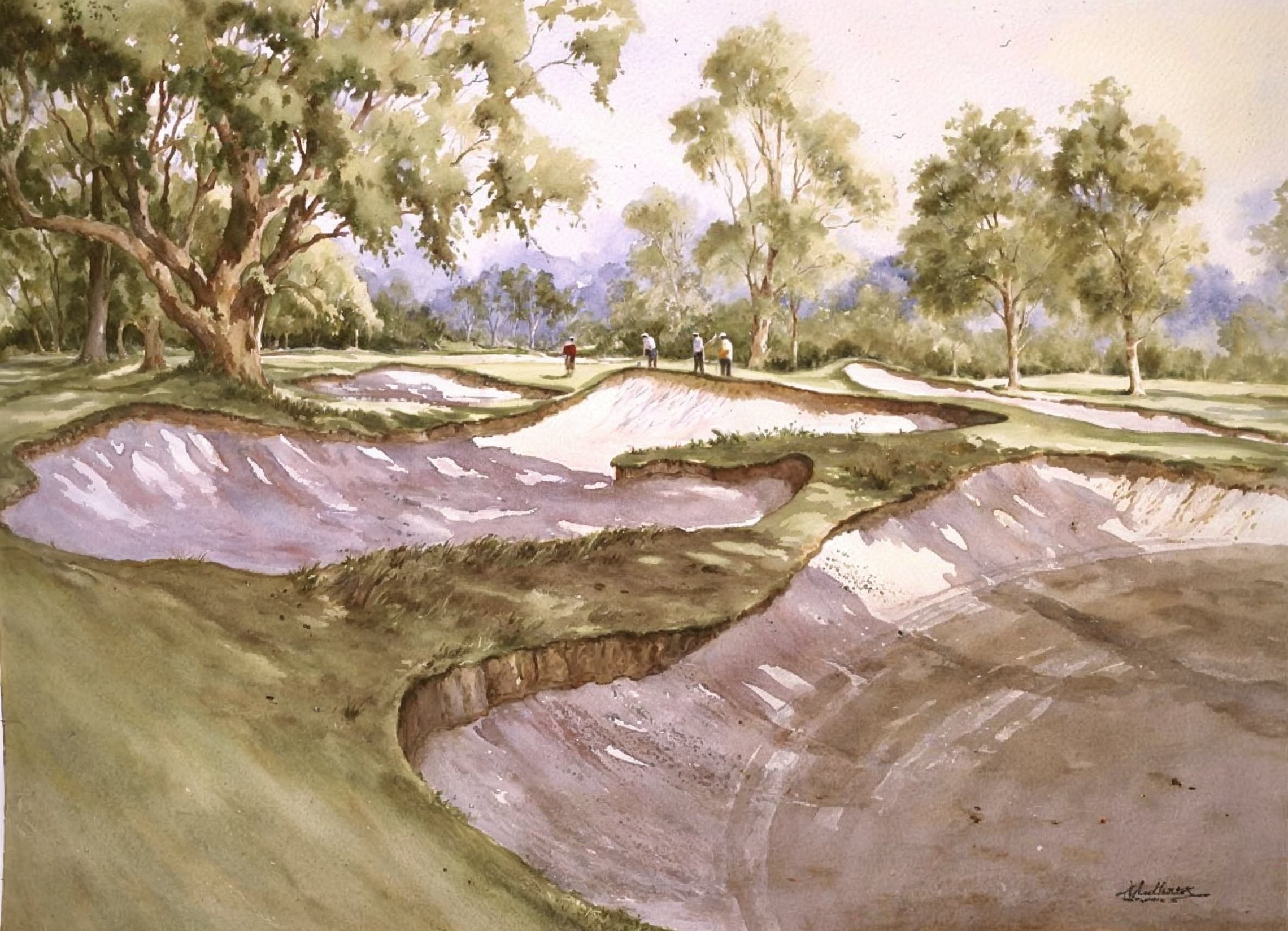
Shadows on the Seventh
By Robert Wade
Our Featured Holes
4th
The Tabletop
Perhaps the most talked-about hole on the course. It is a short, straight driveable par 4 with no bunkers around the green. However, the green is a narrow tabletop that demands absolute precision. If you miss left or right, you face a near-impossible up-and-down. It is the ultimate test of “risk vs. reward.
5th
The Sandbelt Classic
Architecturally, this hole is a masterpiece of bunkering. It is often compared to the 5th at Royal Melbourne (West). It requires astute club selection into a narrow green protected by deep, yawning bunkers. It is a par 3 that rewards the courageous but punishes the careless
13th
The Strategist
While reachable for long hitters, the 13th is best played with a cool head. The strategic move is to position your ball short-left of the green to provide the ideal angle into a narrow, well-protected target. It is a definitive example of why strategy trumps strength at Woodlands.